ISSUE 015 · Oct 17, 2026 · 9 min read
What if spinal stimulation adapted each time the hand began to fatigue?
In chronic incomplete cervical spinal cord injury, adapt transcutaneous spinal stimulation to EMG, movement, and task success—within therapist-set bounds—and test whether it improves real-world hand use beyond fixed stimulation.
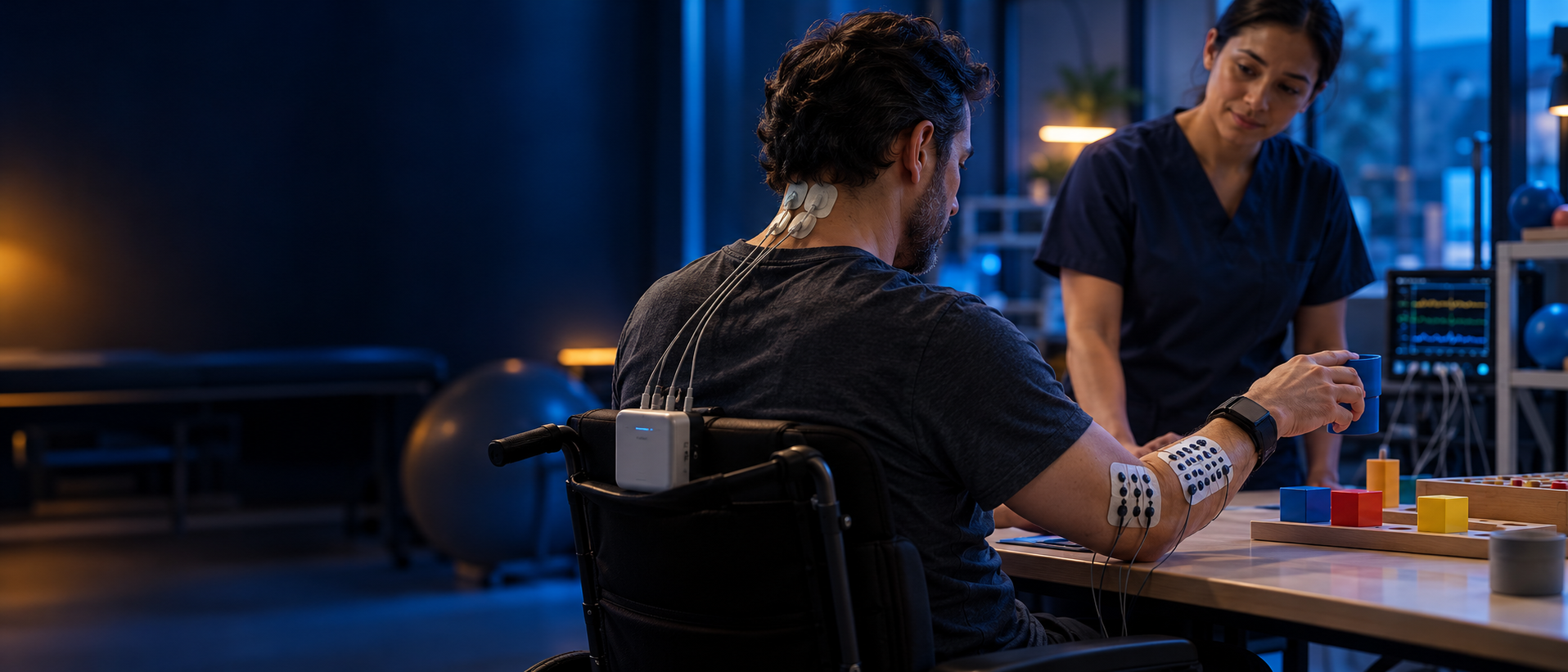
A bounded loop in which hand state changes stimulation
ANM proposed model. It adds signal-quality checks, fatigue estimation, bounded parameter changes, and real-world hand-use measurement to the authorized clinic-based stimulation-plus-task-practice framework. Adaptive control itself is not yet a clinically proven function.
Authorized potential—and the missing comparison
Up-LIFT enrollees who completed the four-month protocol
Participants exceeding minimal important differences in both strength and function after the stimulation phase
Device-related serious adverse events in the 64-person safety population
Single-arm sequence of two months rehabilitation, then two months stimulation plus rehabilitation
Strength and sensation signals are established; function and adaptive control are not
Established: the 2024 Up-LIFT study enrolled 65 people at 14 centers; 60 completed two months of rehabilitation alone followed by two months of the same rehabilitation plus non-invasive cervical spinal stimulation. Forty-three (72%) met minimal important-difference criteria in both strength and function, with no device-related serious adverse events in the 64-person safety population. But this was a sequential single-arm study without a randomized concurrent control. In December 2024, FDA granted De Novo Class II authorization for prescription ARC-EX use with in-clinic functional task practice to improve hand sensation and strength in people aged 18–75 with chronic, non-progressive C2–C8 incomplete SCI. FDA explicitly stated that device effects apart from intensive outpatient rehabilitation, functional benefit, and durability were not demonstrated. Clinical superiority of sensor-guided adaptation, therapist-time savings, home use, and reimbursement are venture and research hypotheses.
Failure conditions and safety, ethics, and regulatory risks
Do not claim personalization superiority if the adaptive arm misses its prespecified week-16 GRASSP prehension difference versus fixed stimulation, or if home hand use and SCIM self-care do not improve directionally.
Check every session for autonomic dysreflexia, blood-pressure or heart-rate change, spasm, pain, burns, and skin irritation. Require bladder and bowel precautions, infection and fever screening, vital-sign and skin stop rules, immediate manual stop, and an independent DSMB.
EMG artifact, electrode shift, or spasticity mistaken for fatigue can trigger unsafe changes. Disable adaptation below a signal-quality threshold; bound step size, frequency, and cumulative charge; and audit every proposal and therapist override.
Prespecify subgroup error analyses by skin impedance, body habitus, injury level, AIS grade, and sex. Measure travel and caregiver burden, and separately confirm understanding that this is an adjunctive rehabilitation device—not a cure for paralysis or proven neural regeneration.
DEN240014 covers programmed stimulation with in-clinic functional task practice; it does not authorize real-time sensor-AI adaptation or home therapy. A separate FDA strategy and clinical evidence may be required for the algorithm, software, wireless functions, cybersecurity, and human factors. Do not transfer the authorized device’s name or outcomes into efficacy claims for an adaptive product.
Stop commercialization if sensor setup and review fail to reduce therapist time, cross-center reproducibility is poor, or total episode cost exceeds willingness to pay—even if a functional signal exists.
References
Established facts are separated from research and venture hypotheses that still require validation.
- 01
Moritz C, Field-Fote EC, Tefertiller C, et al. Non-invasive spinal cord electrical stimulation for arm and hand function in chronic tetraplegia: a safety and efficacy trial. Nat Med. 2024;30:1276–1283.
A prospective, single-arm sequential study at 14 centers. Among 60 completers, 72% met minimal important-difference criteria in both strength and function, without a concurrent control.PMID 38769431 · NCT04697472 - 02
ClinicalTrials.gov. The Up-LIFT Study of Non-Invasive ARC Therapy for Spinal Cord Injury.
Primary registry record for the population, intervention, endpoints, and design of the non-invasive spinal stimulation study.NCT04697472 - 03
U.S. Food and Drug Administration. ARC-EX System, De Novo Classification Request.
Official De Novo record classifying the transcutaneous electrical spine stimulator as Class II. No predetermined change control plan was authorized.DEN240014 · Decision Dec 19, 2024 - 04
U.S. Food and Drug Administration. De Novo Summary: ARC-EX System.
Primary regulatory source defining the indication, prescription and clinic-use limits, unproven functional benefit and durability, contraindications, and autonomic, skin, and musculoskeletal risks.DEN240014 · 15-page decision summary