ISSUE 007 · Oct 9, 2026 · 8 min read
What if neuromodulation woke only as the bladder filled?
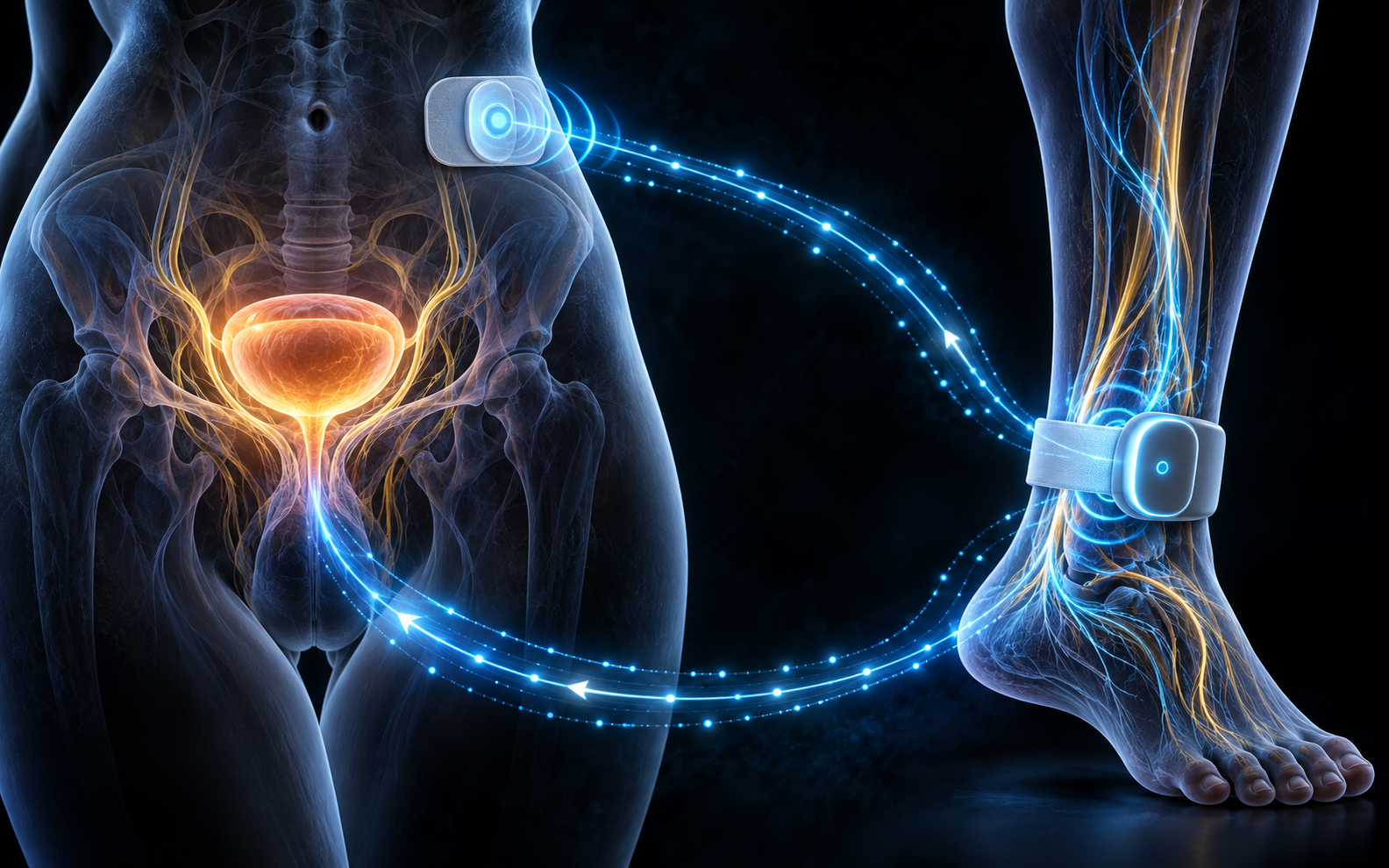
The hypothesis: instead of stimulating on a fixed schedule, a wearable ultrasound sensor could track each person’s bladder-filling trajectory and adjust the timing—not the unbounded dose—of transcutaneous tibial nerve stimulation to reduce urgency incontinence and treatment burden together.
From bladder filling to bounded stimulation
ANM proposed model. Validate current EMG-based stimulation confirmation and investigational bladder ultrasound separately, then connect them only within clinician-approved timing and intensity bounds.
Cleared components—and the unproven connection
FDA 510(k) decision date for the non-invasive wearable Vivally tibial-nerve stimulator
Open-label, single-arm FREEOAB cohort; mean 12-week adherence was 88.5%
Size of the later sham-controlled trial; paper retracted in March 2026 over analyses outside the prespecified plan
Evidence level for the 2024 flexible ultrasound patch for continuous bladder monitoring
Established facts—and the evidence gap after retraction
Established: in April 2023, FDA cleared a non-invasive wearable that uses EMG to confirm tibial-nerve activation and adjust stimulation for urinary urgency and urgency incontinence. The 96-person, single-arm FREEOAB study reported symptom improvement and 88.5% adherence, but had no comparator and investigators were sponsor-funded. A later 125-person randomized sham-controlled paper was retracted in March 2026 because symptom-event analyses and comparisons outside the original protocol endpoints and analysis plan affected its findings and conclusions. Separately, a 2024 Nature Communications flexible ultrasound patch demonstrated continuous bladder monitoring in healthy volunteers; it has not been validated as a treatment controller in people with OAB. Clinical effect, safety, and purchasing value for bladder-state timing therefore remain hypotheses requiring a new, rigorously prespecified test.
Failure conditions and safety, ethics, and regulatory risks
Drop the state-adaptation claim unless the adaptive arm reduces daily urgency-incontinence by at least 0.5 episodes beyond fixed active therapy and reaches the OAB-q minimal clinically important difference.
Obesity, scars, bladder position, motion, and skin contact can alter ultrasound quality. Never treat unreadable data as normal; revert to fixed scheduling and publish unreadable rates by subgroup.
Weak stream, hematuria, recurrent infection, pelvic pain, or high residual volume is not automatically labeled OAB. Assess urinalysis, post-void residual, and obstruction risk before adaptation; stop stimulation if these worsen.
In the first trial, cap total exposure and intensity identically across active arms. Monitor skin injury, pain, spasm, falls, electrode misplacement, and contraindicated implants; provide a patient stop control.
Voiding, leakage, and activity data are highly sensitive. Minimize raw-image and location collection, give patients deletion and sharing controls, and never expose inferred scores to employers or family members.
The existing 510(k) covers EMG-confirmed stimulation, not a combined loop that automatically retimes therapy from bladder ultrasound. FDA-guided validation of sensor failure, controller stability, human factors, and cybersecurity—and a separate premarket submission—may be required. Reject the episode model if adoption is below 70% or clinic review time increases.
References
Established facts are separated from research and venture hypotheses that still require validation.
- 01
U.S. Food and Drug Administration. Vivally System Wearable, Non-Invasive Neuromodulation System and Mobile Application. 510(k) K220454.
Primary regulatory record for a non-implanted transcutaneous peripheral-nerve stimulator for urgency and urgency incontinence; it links trial NCT04547920.K220454 · Apr 3, 2023 - 02
Goudelocke C, Sobol J, Poulos D, et al. A Multicenter Study Evaluating the FREquency of Use and Efficacy of a Novel Closed-Loop Wearable Tibial Neuromodulation System for Overactive Bladder and Urgency Urinary Incontinence (FREEOAB). Urology. 2024;183:63–69.
An open-label, single-arm study of 96 people reporting symptom, quality-of-life, and 88.5% adherence findings; it cannot establish comparative efficacy.PMID 37944596 · NCT04547920 - 03
Goudelocke C, Dhir R, Shapiro E, et al. Retraction notice to “A Multicenter Prospective Sham-controlled Trial Evaluating a Physiologic Closed-loop Wearable Tibial Neuromodulation System for Overactive Bladder.” Urology. 2026;209:170.
The editor retracted the paper because symptom-event analyses and comparisons outside the original protocol affected findings and conclusions. Its efficacy estimates are not used as evidence here.PMID 41832048 · Mar 2026 - 04
Toymus AT, Yener UC, Bardakci E, et al. An integrated and flexible ultrasonic device for continuous bladder volume monitoring. Nat Commun. 2024;15:7216.
Demonstrated a flexible air-backed ultrasound patch and wireless electronics in healthy volunteers; it was not an OAB treatment-control trial.PMID 39174518 · DOI 10.1038/s41467-024-50397-8 - 05
U.S. Food and Drug Administration. Technical Considerations for Medical Devices with Physiologic Closed-Loop Control Technology. Final Guidance.
FDA recommendations for design, nonclinical testing, and labeling when sensors, controllers, and actuators automatically adjust energy from physiologic feedback.FDA · Sep 2023