ISSUE 014 · Oct 16, 2026 · 9 min read
What if every treatment briefly opened the wall blocking brain-tumor drugs?
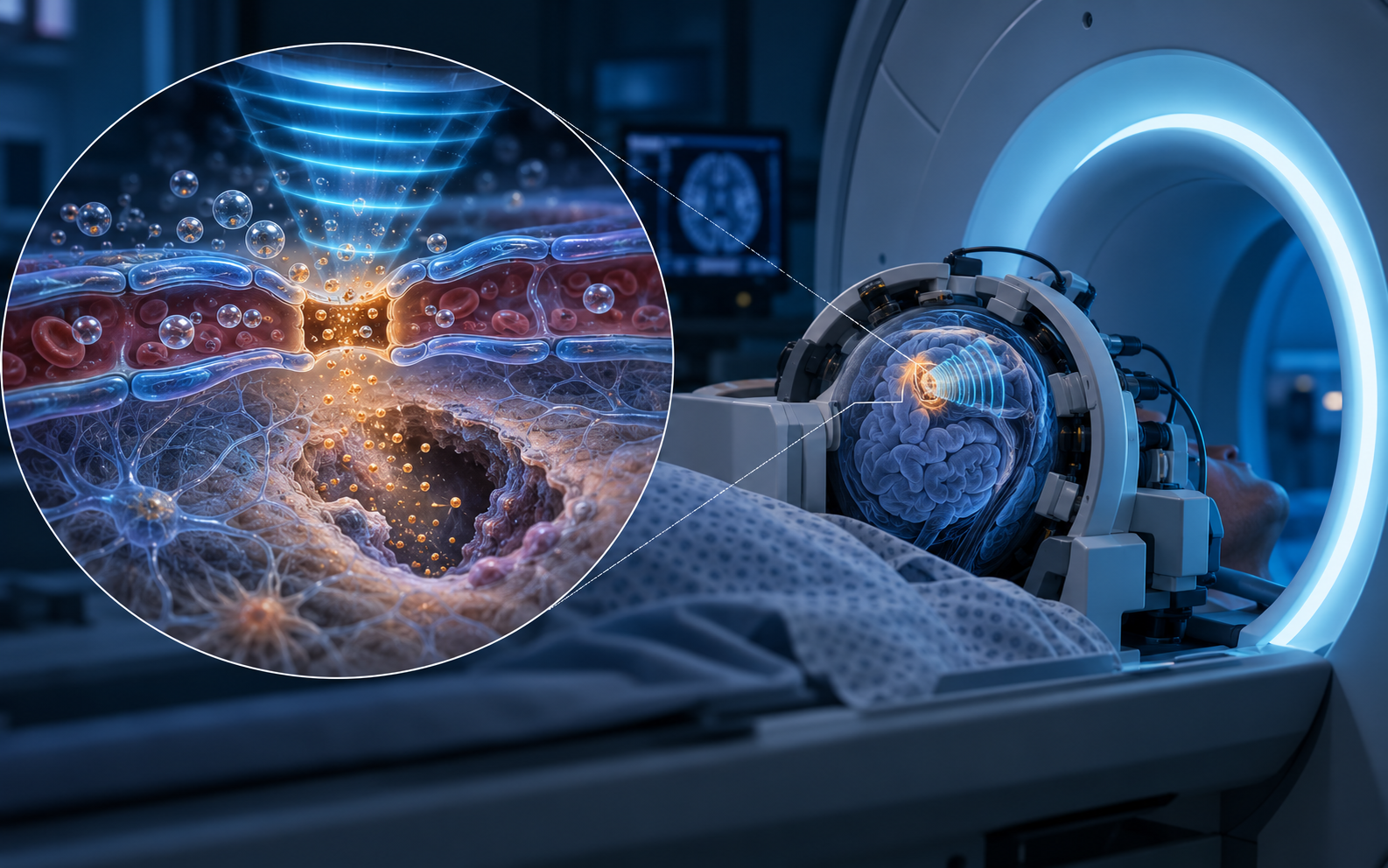
In recurrent glioblastoma, transiently open the blood–brain barrier with low-intensity pulsed ultrasound and microbubbles, then compare against the same chemotherapy alone to test whether higher drug exposure becomes longer progression-free survival.
The proof chain from barrier opening to patient benefit
ANM proposed model. MRI-visible opening and higher tissue drug concentration are intermediate endpoints. A same-drug control must connect them to tumor control, neurotoxicity, and survival.
The gap between delivery success and treatment success
Mean increase in albumin-bound paclitaxel concentration in sonicated brain tissue in a 17-person phase 1 trial
Mean increase in carboplatin concentration in sonicated brain tissue in the same pharmacokinetic analysis
Repeated sonication exposure in a 2024 single-arm phase 1/2 trial
Reported 14.0-month median overall survival cannot establish treatment effect
The barrier opened in humans; longer survival is not yet established
Established: in a 17-person phase 1 study published in 2023, opening after repeated low-intensity pulsed ultrasound with microbubbles diminished over about one hour. Mean drug concentration in sonicated versus non-sonicated brain was 3.7 times higher for albumin-bound paclitaxel and 5.9 times higher for carboplatin. Transient grade 1–2 headache was common; one grade 3 encephalopathy occurred in cycle one at 260 mg/m². In a 2024 single-arm phase 1/2 study, 33 people underwent 90 monthly sessions, MRI opening was seen at 90% of emitters, and no dose-limiting toxicity occurred; grade 3 presyncope, fatigue, wound infection, and connector pain were reported. Median overall survival of 14.0 months in the 12 people given carboplatin immediately before sonication is a nonrandomized exploratory result. Clinical benefit, cost-effectiveness, and drug generalizability therefore remain venture assumptions pending registered follow-up results and a randomized same-drug comparison.
Failure conditions and safety, ethics, and regulatory risks
Do not scale unless the prespecified six-month progression-free-survival target is met with a hazard ratio of 0.70 or lower and overall-survival and function trends are directionally consistent. MRI opening and tissue drug concentration cannot substitute for patient benefit.
An independent DSMB pauses the study if symptomatic intracranial hemorrhage exceeds 3% or opening-attributable grade ≥3 neurotoxicity exceeds 10%. Use real-time acoustic stop thresholds, pre/post MRI, and 24-hour neurologic observation.
Independently adjudicate infection, skin breakdown, connector pain, reoperation, and explantation. Do not perform craniotomy solely for device placement in patients without a clinical indication for repeat surgery.
Opening is futile when the tumor resists the drug. Use a same-drug control, spatial pharmacokinetics, and prespecified sensitivity analyses to distinguish a well-delivered ineffective drug.
Dependence on tertiary surgery, MRI, and repeated visits can widen geographic and income disparities. Measure travel and caregiver costs, and test understanding separately to limit therapeutic misconception.
FDA P150038 authorizes thermal thalamotomy for essential tremor; it does not authorize blood–brain barrier opening or glioblastoma drug delivery. The implant–microbubble–drug combination may require a separate IDE and combination-product strategy. Stop commercialization if center-level reproducibility is poor or total per-treatment cost is not proportional to clinical value.
References
Established facts are separated from research and venture hypotheses that still require validation.
- 01
Sonabend AM, Gould A, Amidei C, et al. Repeated blood–brain barrier opening with an implantable ultrasound device for delivery of albumin-bound paclitaxel in patients with recurrent glioblastoma: a phase 1 trial. Lancet Oncol. 2023;24(5):509–522.
A phase 1 study of 17 people and 68 sessions showing barrier opening and higher brain drug concentration—not randomized clinical efficacy.PMID 37142373 · NCT04528680 - 02
Carpentier A, Stupp R, Sonabend AM, et al. Repeated blood–brain barrier opening with a nine-emitter implantable ultrasound device in combination with carboplatin in recurrent glioblastoma: a phase I/II clinical trial. Nat Commun. 2024;15:1650.
A single-arm study of 33 people and 90 sessions supporting repeated-opening feasibility and safety signals, without a survival comparator.PMID 38396134 · NCT03744026 - 03
ClinicalTrials.gov. Ultrasound-based blood-brain barrier opening and albumin-bound paclitaxel plus carboplatin in recurrent glioblastoma.
Registry for the follow-up drug-combination study; registration and conduct do not establish benefit.NCT04528680 - 04
ClinicalTrials.gov. Safety and efficacy of transient opening of the blood-brain barrier with the SonoCloud-9.
Primary registry record for the design and endpoints of the single-arm phase 1/2 study reported in 2024.NCT03744026 - 05
U.S. Food and Drug Administration. ExAblate Model 4000 Type 1.0 System (ExAblate Neuro). Premarket Approval P150038.
Confirms that the approved indication for this MR-guided focused-ultrasound system is unilateral thalamotomy for medication-refractory essential tremor—not barrier opening or tumor therapy.P150038 · Decision Jul 11, 2016