ISSUE 003 · Oct 5, 2026 · 8 min read
What if deep brain stimulation could follow the rhythm of gait?
Detect emerging gait freezing from wearable and neural signals, then adjust stimulation by gait phase inside clinician-defined safety bounds.
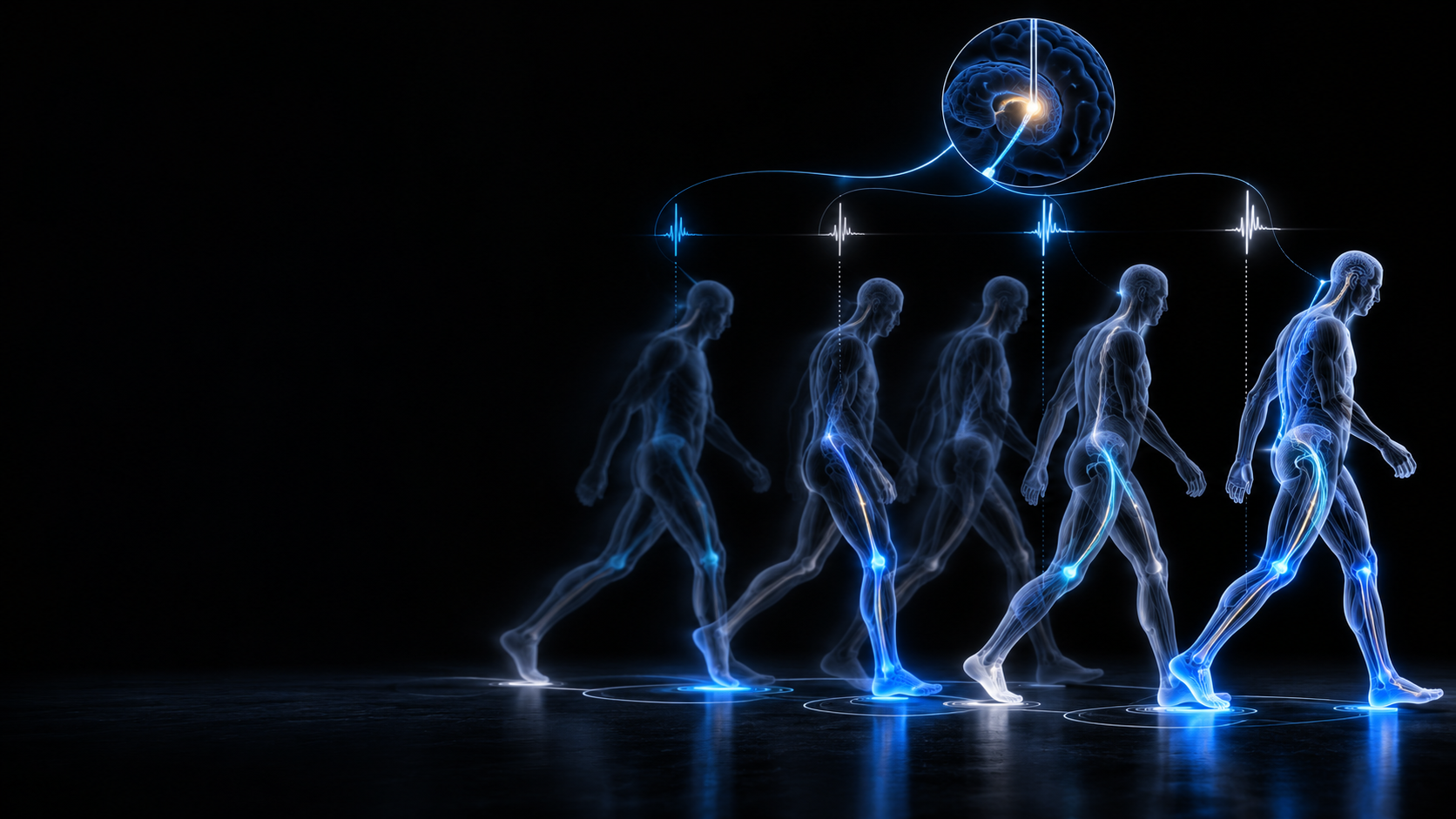
A closed loop paced by gait state
ANM proposed model. It connects approved neural-signal adaptive DBS with a 2026 gait-synchronization feasibility study while keeping the gait algorithm explicitly investigational.
The gait gap between authorization and clinical value
FDA PMA supplement approval of an optional adaptive DBS feature
Enrollment in the pivotal long-term at-home ADAPT-PD trial
Mean change in delivered electrical energy with single-threshold aDBS versus continuous DBS
Size of the gait-synchronized aDBS study; three completed the at-home crossover
What is established—and what is not
Established: FDA approved an optional adaptive feature for an existing DBS system in February 2025. In the 68-person ADAPT-PD study, both aDBS modes met the prespecified performance goal, and single-threshold aDBS delivered 15% less electrical energy on average than continuous DBS. Participants were already stable on continuous DBS and medication, and the study was manufacturer-supported. A 2026 gait-synchronized study identified personalized gait-phase biomarkers in five people, but only three completed the at-home crossover. Reduced falls and broad generalizability therefore remain hypotheses.
Failure conditions and safety, ethics, and regulatory risks
Do not claim superiority unless real-world freezing falls by at least 20% without worsening falls, speech, or overall motor control.
On signal loss, sensor detachment, or out-of-distribution gait, stop adaptation and revert immediately to the clinician-validated continuous setting.
Gait gains can coexist with dyskinesia, impaired speech, or worse balance. Predefine patient-specific amplitude bounds, ramp rates, and daily exposure.
Selecting only patients with clean signals and easy wearable use limits generalizability. Report cognitive impairment, mobility-aid use, and diverse gait phenotypes separately.
The 2025 approval covers a specific neural-signal adaptive feature. A gait-phase algorithm and new stimulation policy are not automatically covered and may require an IDE and PMA supplement.
Do not scale if total programming, visit, and training costs exceed standard DBS without patient-level improvement in freezing or falls.
References
Established facts are separated from research and venture hypotheses that still require validation.
- 01
U.S. Food and Drug Administration. Activa®, Percept™ and SenSight™ Deep Brain Stimulation Therapy System. PMA P960009/S478.
Primary regulatory record for the approval date and indication of the optional adaptive DBS programming feature.P960009/S478 · Feb 20, 2025 - 02
Bronte-Stewart HM, Beudel M, Ostrem JL, et al. Long-Term Personalized Adaptive Deep Brain Stimulation in Parkinson Disease: A Nonrandomized Clinical Trial. JAMA Neurol. 2025;82(11):1171–1180.
A 68-person international pivotal trial supporting performance and energy findings, but not a direct test of gait benefit versus continuous DBS.PMID 40982287 · NCT04547712 - 03
Oehrn CR, Cernera S, Hammer LH, et al. Chronic adaptive deep brain stimulation versus conventional stimulation in Parkinson’s disease: a blinded randomized feasibility trial. Nat Med. 2024;30:3345–3356.
A four-person personalized aDBS feasibility study demonstrating symptom-specific biomarker selection.PMID 39160351 - 04
Louie KH, Balakid JP, Bath JE, et al. Adaptive deep brain stimulation for dynamic gait control in Parkinson’s disease: a randomized feasibility trial. Nat Med. 2026;32:2803–2814.
Identified gait-phase biomarkers in five participants; three completed the at-home crossover. Fall reduction is exploratory and requires confirmation.PMID 42297980 · NCT04675398 - 05
ClinicalTrials.gov. Adaptive Deep Brain Stimulation for Freezing of Gait in Parkinson’s Disease.
Registry evidence that adaptive DBS specifically targeting freezing of gait is under investigation.NCT06819020