ISSUE 020 · Oct 22, 2026 · 9 min read
If we knew today which burns would not heal within 21 days, could we change care and transfer sooner?
Between an authorized adjunct and an unproven care pathway
FDA DEN250028 De Novo authorization date
Authorized healing-potential horizon under conservative care
Sensitivity / specificity in a 2025 UK multicenter evaluation
MSI versus laser Doppler accuracy in a separate 31-wound pilot
Authorization opens the door; it does not prove pathway effectiveness
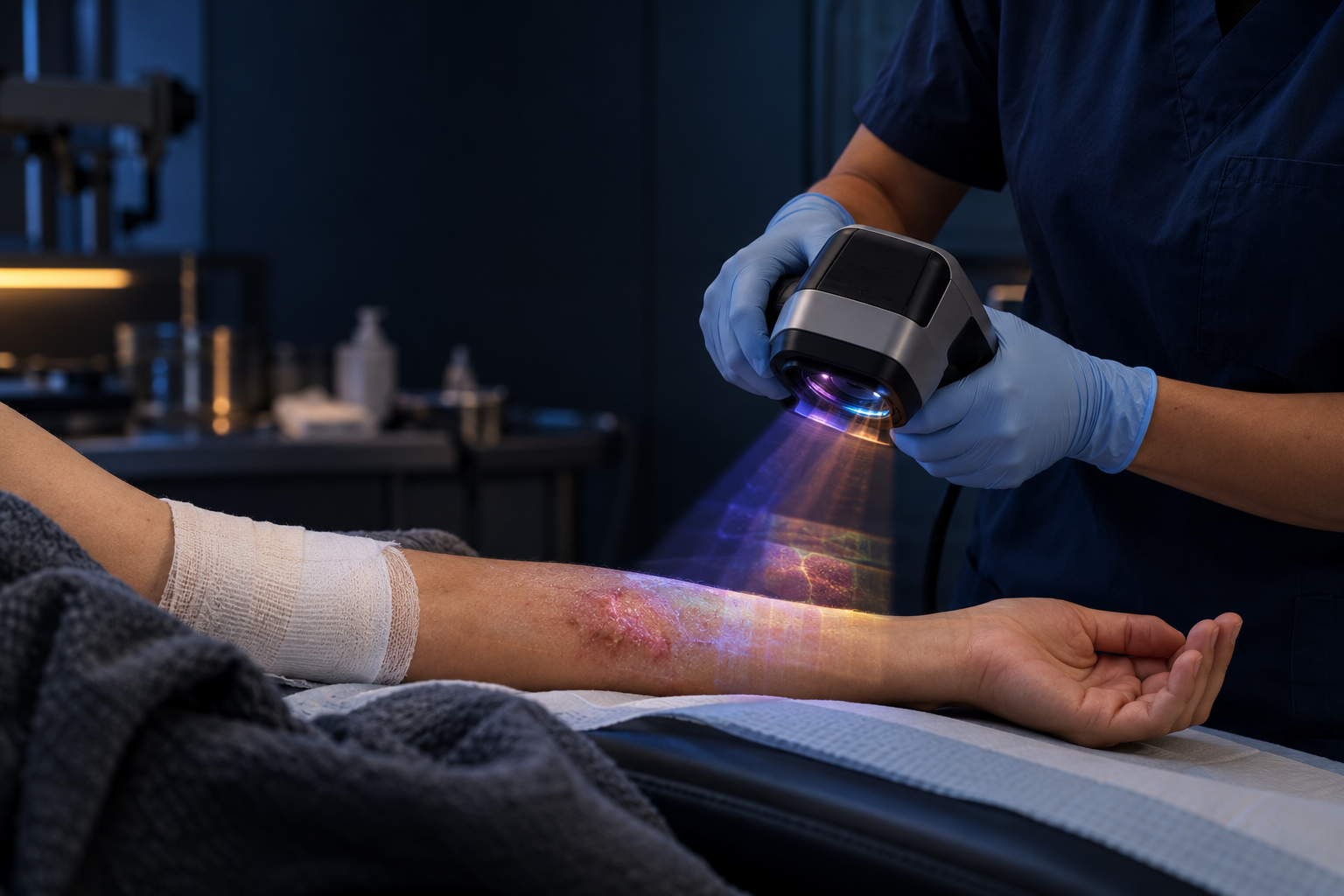
Established: FDA granted Class II De Novo authorization to the DeepView AI System on May 21, 2026. Its software highlights deep partial- and full-thickness thermal burn tissue and areas unlikely to heal within 21 days with conservative treatment alone, but it is an adjunct to clinical assessment—not a standalone diagnosis or a precise excision-margin tool.
A 2025 UK multicenter observational evaluation reported 80. 7% sensitivity and 95.
5% specificity, with wide uncertainty and no randomized test of pathway or patient outcomes. In a separate 31-wound pilot, MSI matched clinical management in 58% of cases versus 90% for laser Doppler imaging, underscoring device- and setting-dependence and the need for independent validation.
Registered study NCT06131203 collected device-validation data; it was not a randomized test of a service model improving transfer, surgery, scar, or cost. The proposed study size, time and transfer effects, and business model are ANM hypotheses.
Failure conditions and safety, ethics, and regulatory risks
Do not scale if time to the correct plan falls by less than 24 hours, missed nonhealing wounds cross the 3-point noninferiority margin, or avoidable transfer among wounds healed by day 21 falls by less than 20%. Imaging accuracy alone is not success.
A false negative can delay grafting and worsen infection or scarring. Maintain specialist escalation regardless of output when pain, perfusion, infection, wound evolution, or clinician concern warrants it, with reassessment at 24–48 hours.
A highlighted region is not an excision boundary. Prohibit AI-only transfer or surgery; require burn-surgeon confirmation, an option for conservative reassessment, and audit of surgical and donor-site harms.
Prespecify performance by skin tone, age, anatomical site, residual dressings, blistering, eschar, lighting, and distance. Failed quality checks trigger preparation and recapture rather than inference; eye-adjacent and other unvalidated complex sites follow separate protocols.
Wound images may contain identifying body marks and pediatric data. Separate consent for care, audit, and model training; minimize data and define encryption and deletion periods.
Audit transfer and outcomes by language, distance, insurance, and geography so deployment does not benefit only large networks.
DEN250028 authorizes adjunctive wound assessment, not autonomous surgery or transfer. New anatomical sites, sensors, models, alert language, automated prioritization, or treatment recommendations may require additional regulatory review.
Contracts must define version lock, drift surveillance, standard care during downtime, and the accountable clinician.
References
Established facts are separated from research and venture hypotheses that still require validation.
- 01
U.S. Food and Drug Administration. DeepView AI System, De Novo Classification Order.
Primary regulatory source for the 21-day healing-potential output, Class II classification, adjunctive use, and limitations against standalone diagnosis or excision-margin use.DEN250028 · May 21, 2026 - 02
Tan P, Nyeko-Lacek M, Walsh K, Sheikh Z, Lewis CJ. Artificial intelligence-enhanced multispectral imaging for burn wound assessment: Insights from a multi-centre UK evaluation. Burns. 2025;51(8):107550.
A prospective multicenter observational evaluation at two UK burn centers. It suggests performance potential but has limited sample precision and does not test pathway effectiveness.PMID 40858093 · DOI 10.1016/j.burns.2025.107550 - 03
Perusseau-Lambert A, Akram M, Frew Q, Barnes D. Comparison between multispectral imaging and laser Doppler imaging to predict burn wound requirements for surgery. Burns. 2025;51(8):107650.
A 31-wound pilot reporting 58% accuracy for MSI and 90% for LDI, supporting the need for independent validation and clinician integration.PMID 40834474 · DOI 10.1016/j.burns.2025.107650 - 04
ClinicalTrials.gov. Burn Validation Study: DeepView SnapShot Portable.
A registered adult and pediatric thermal-burn study collecting training and validation data. Registration and device validation do not establish effectiveness of the proposed treatment and transfer pathway.NCT06131203