ISSUE 012 · Oct 14, 2026 · 9 min read
What if a lung nodule could be diagnosed and treated in the same procedure?
For small peripheral lung cancers in patients who cannot undergo surgery, combine robotic bronchoscopy, real-time pathology, CBCT, and microwave ablation in one anesthetic—then validate two-year local control and total treatment burden, not merely target access.
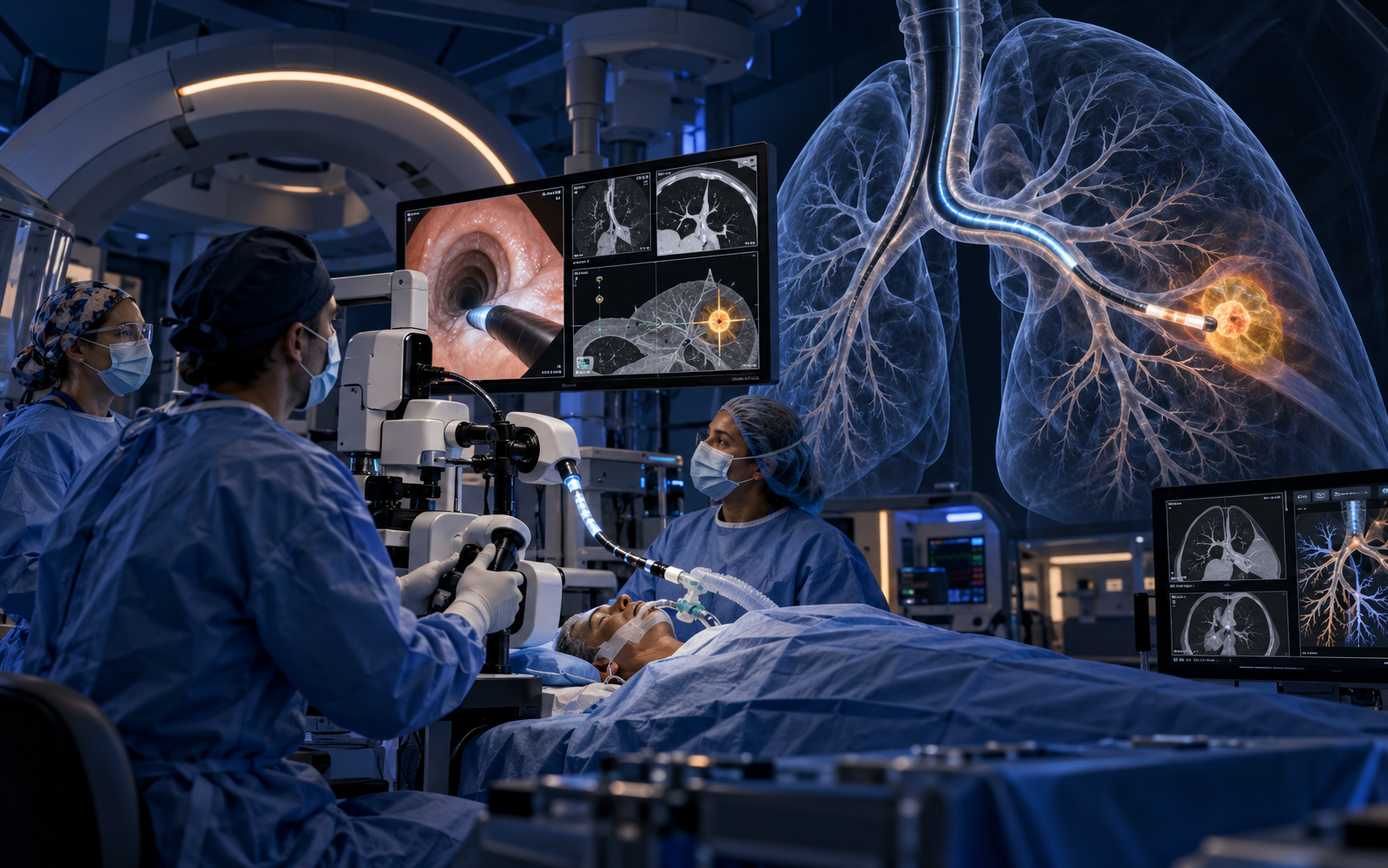
A diagnose-to-treat loop closed under one anesthetic
ANM proposed model. No ablation occurs before malignancy is confirmed, and a clinician verifies CBCT position and margins. Current evidence is small and single-arm, so comparative benefit versus SBRT remains a hypothesis.
The gap between technical success and cancer-control evidence
NAVABLATE prospective single-arm sample; 100% one-month technique efficacy
Grade ≥3 complications in NAVABLATE; none were grade 4 or 5
2025 retrospective robotic series; one pneumonia hospitalization
Imaging-efficacy horizon in the largest prospective study to date
Technical feasibility is established; comparative effectiveness is not
Established: NAVABLATE reported 100% technical success and 100% one-month imaging technique efficacy in 30 malignant nodules ≤30 mm among patients who declined or were ineligible for surgery and SBRT. There were no deaths or pneumothoraces, but four participants (13.3%) had grade 3 complications and no long-term comparative local-control endpoint was tested. A 2025 shape-sensing robotic series biopsied and confirmed malignancy by ROSE before same-anesthetic ablation in nine people with 11 lesions and reported 100% technical success; one person developed pneumonia requiring hospitalization, and only three lesions were primary lung cancers. A separate multicenter diagnose-stage-treat-then-resect study is now testing histopathologic treatment effect. FDA records classify robotic bronchoscopes as Class II airway-access and visualization devices; that does not itself establish effectiveness of a specific bronchoscopic MWA cancer-treatment pathway. Replacement of SBRT, two-year cancer control, and cost savings therefore remain hypotheses.
Failure conditions and safety, ethics, and regulatory risks
Do not claim replacement of SBRT or scale the pathway if the confidence bound for 24-month local-control noninferiority crosses 7.5 percentage points. Technical success or early imaging change cannot substitute.
Do not ablate when ROSE is indeterminate or EBUS suggests N1–N3 disease. Independently audit final-pathology discordance and inadequate tissue for molecular testing; never treat benign or unresolved nodules.
Prespecify minimum distances from major vessels, central airways, and esophagus plus stop thresholds. Independently adjudicate pneumonia, airway injury, hemoptysis, pleural injury, and anesthesia complications through 30 days.
Atelectasis, hemorrhage, and respiratory motion can distort CBCT margins. Present AI output with uncertainty and image quality; never auto-recommend additional energy when imaging is poor.
NAVABLATE procedure time and repeated CBCT show that one procedure is not automatically low burden. Compare cumulative radiation, room and anesthesia time, staffing, and cancellations against the full SBRT pathway.
Authorization for bronchoscopic access and visualization does not authorize a specific ablation catheter, integrated workflow, or AI margin claim. Seek early FDA feedback and assess IDE requirements; use independent tumor-board review and public outcomes so per-ablation revenue cannot reward treatment of uncertain nodules.
References
Established facts are separated from research and venture hypotheses that still require validation.
- 01
Lau KKW, Lau RWH, Baranowski R, Krzykowski J, Ng CSH. Transbronchial Microwave Ablation of Peripheral Lung Tumors: The NAVABLATE Study. J Bronchology Interv Pulmonol. 2024;31(2):165–174.
A 30-person, two-center prospective single-arm study reporting 100% one-month technique efficacy, 3.3% device-related adverse events, and 13.3% grade ≥3 complications, without long-term comparative control.PMID 37747275 · NCT03569111 - 02
Xu L, Gong W, Tran B, et al. Shape-Sensing Robotic-Assisted Bronchoscopic Microwave Ablation for Primary and Metastatic Pulmonary Nodules: Retrospective Case Series. Diagnostics. 2025;15(24):3248.
A retrospective series of nine people and 11 lesions using ROSE-confirmed same-anesthetic ablation; technical success was 100%, one patient was hospitalized with pneumonia, and only three lesions were primary lung cancers.PMID 41464247 · DOI 10.3390/diagnostics15243248 - 03
Beattie J, Parrish R, Ayasa L, et al. Safety and feasibility of bronchoscopic microwave ablation technology for peripheral lung cancer: a multi-center, prospective, single-arm study protocol. BMC Surg. 2025;25:497.
A prospective protocol for diagnosing, staging, and ablating resectable primary lung cancers ≤3 cm, followed by surgery at two to four weeks for histopathologic assessment.PMID 41137055 · NCT05281237 - 04
ClinicalTrials.gov. Bronchoscopic Microwave Ablation of Peripheral Lung Tumors.
Registry for the ongoing study of bronchoscopic MWA safety, feasibility, and post-resection pathologic response.NCT05281237 · Registered Mar 15, 2022 - 05
U.S. Food and Drug Administration. Ion Endoluminal System 510(k) Summary.
Primary regulatory record for airway access, visualization, and instrument delivery by a shape-sensing bronchoscope; it is not authorization evidence for bronchoscopic MWA cancer effectiveness.K182188 · Cleared Feb 14, 2019 - 06
U.S. Food and Drug Administration. Monarch Endoscopy Platform 510(k) Premarket Notification.
FDA record classifying the robotic platform as a Class II bronchoscope; it does not establish clinical effectiveness of an integrated treatment pathway.K173760 · Decision Mar 22, 2018