ISSUE 009 · Oct 11, 2026 · 8 min read
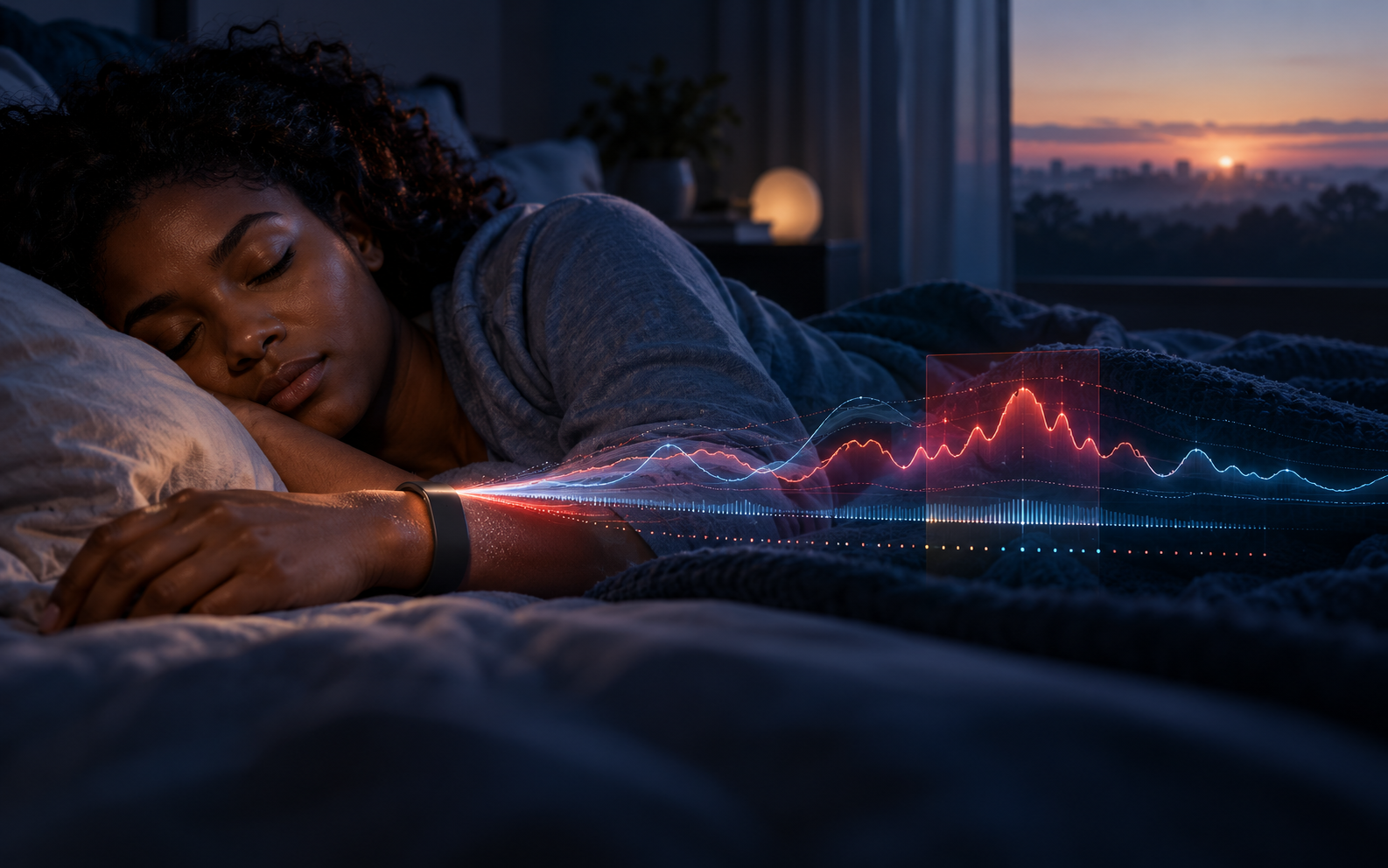
What if tomorrow’s pain crisis appeared on the wrist tonight?
Turn nocturnal vasoconstriction trajectories in sickle cell disease into a 72-hour risk window—and make the product accountable for same-day confirmation and access, not merely an alert.
From a nocturnal signal to faster pain care
ANM proposed model. The small 2026 PPG feasibility signal is not treated as evidence of clinical benefit; prospective silent validation must precede any care activation.
Feasibility exists; prediction remains unproven
People with sickle cell disease in the 2026 wrist-PPG study
Nocturnal wrist-PPG recordings collected from patients
Overnight wrist-to-finger PPG correlation range across nine nights
Single-center 2023 sample exploring wearable pain models through 30 days after discharge
Observed signals versus the untested care thesis
Established: a January 2026 study collected wrist PPG from 12 people with sickle cell disease and six healthy controls. Nocturnal vasoconstriction metrics were feasible across 131 nights, including 79 patient nights; simultaneous wrist-to-finger comparison covered only nine nights in three healthy controls. It did not test prediction of imminent crises or clinical outcomes. Two 2023 single-center studies of 20 and 19 people likewise modeled pain that had already occurred. ASH now frames time from ED arrival to first analgesic as an equity quality measure. Prediction within 72 hours, fewer ED visits through same-day routing, and a viable per-member-month service therefore remain hypotheses.
Failure conditions and safety, ethics, and regulatory risks
Do not activate clinical alerts if the test model fails to improve AUPRC by at least 0.10, yields PPV below 25% at 70% sensitivity, or exceeds two false alerts per patient-month.
Melanin, low perfusion, sensor pressure, and motion can alter optical waveforms. Report unreadable rates and performance by objective skin tone, perfusion, and device; halt launch if sensitivity differs by more than ten percentage points in the darkest-skin group.
A low score must never delay care for fever, chest pain, dyspnea, neurologic symptoms, or rapidly escalating pain. A high score triggers patient confirmation and clinical assessment—not automatic fluids or opioids.
Prediction without day-hospital capacity, after-hours contact, or transport may only add anxiety. Do not sell to sites unable to contact within two hours and offer same-day in-person or telehealth assessment.
Pain, medication, location, and biosignals are sensitive in insurance and employment. Minimize collection, limit purpose, allow deletion and withdrawal, and contractually bar use of risk scores for coverage decisions or medication-compliance policing.
Existing consumer-wearable functions are not authorization to predict sickle-cell crises. A disease-risk score tied to care routing may be regulated device software, requiring early FDA engagement, analytical and clinical validation, cybersecurity, and human-factors review.
References
Established facts are separated from research and venture hypotheses that still require validation.
- 01
Shah P, Sy S, Chen M, Khoo MCK, Coates TD, Veluswamy S. Wearable Device Photoplethysmography As a Viable Tool to Longitudinally Monitor Vasoconstriction Biomarkers for Predicting Vaso-Occlusive Crisis in Sickle Cell Disease. JMIR Hum Factors. 2026;13:e75465.
A feasibility study of 12 patients, six controls, and 131 nights. Simultaneous wrist-to-finger comparison covered only nine nights in three controls; imminent crisis prediction was not tested.PMID 41494152 · DOI 10.2196/75465 - 02
Vuong C, Utkarsh K, Stojancic R, et al. Use of consumer wearables to monitor and predict pain in patients with sickle cell disease. Front Digit Health. 2023;5:1285207.
Nineteen adults were followed for a median 28 days, yielding 2,395 pain observations. This small single-center model did not establish pre-crisis prediction.PMID 37954032 · DOI 10.3389/fdgth.2023.1285207 - 03
Stojancic RS, Subramaniam A, Vuong C, et al. Predicting Pain in People With Sickle Cell Disease in the Day Hospital Using the Commercial Wearable Apple Watch. JMIR Form Res. 2023;7:e45355.
A 20-person day-hospital feasibility study with median wear time of 2 hours 17 minutes; it modeled pain during treatment rather than validating an early warning.PMID 36917171 · DOI 10.2196/45355 - 04
ClinicalTrials.gov. Blood Flow and Pain Crises in People With Sickle Cell Disease.
A registered mechanistic study of peripheral blood flow and pain crises; it informs biological plausibility but is not a wearable-product effectiveness trial.NCT01568710 - 05
American Society of Hematology. Timely and Equitable Pain Management for Sickle Cell Disease in the Emergency Department. Hematology Quality Measures.
Defines facility-level measures for median time from ED arrival to first analgesic and the gap versus renal-colic care.Accessed Oct 11, 2026 - 06
U.S. Food and Drug Administration. Pulse Oximeters for Medical Purposes: Non-Clinical and Clinical Performance Testing, Labeling, and Premarket Submission Recommendations. Draft Guidance. January 2025.
A nonbinding draft noting that optical-sensor performance can be affected by skin pigmentation; it does not authorize this PPG algorithm.FDA-2023-N-4976